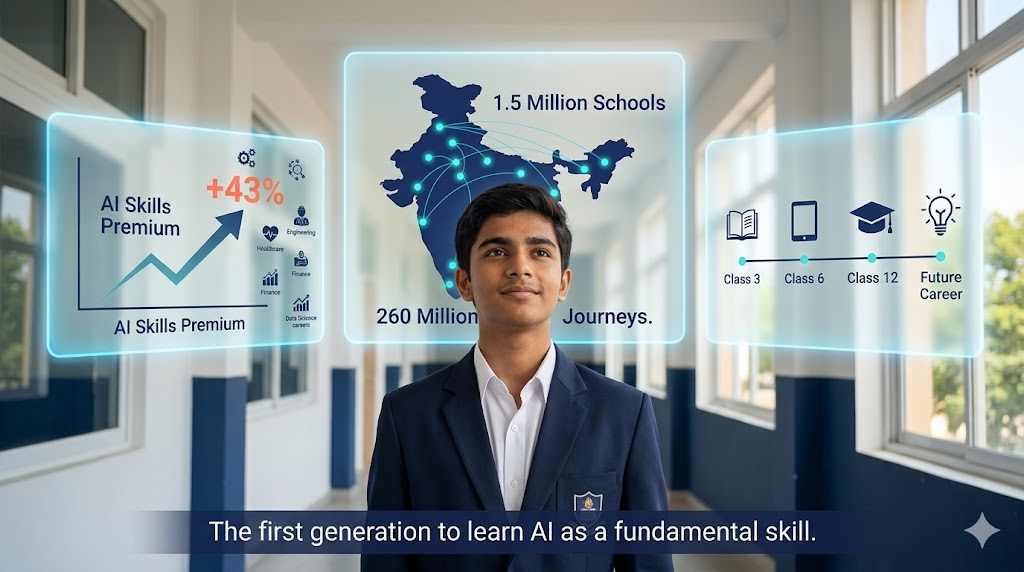
India's 260 million students across 1.5 million schools are witnessing a historic shift—AI education from Class 3 onwards starting 2026-27. But beyond teaching AI as a subject, artificial intelligence is fundamentally reshaping how NCERT content is delivered, assessed, and personalised. Here's what educators need to know.
The NEP 2020 Vision: Why AI Integration Matters Now
The National Education Policy 2020 didn't just suggest digital literacy—it mandated a fundamental rethinking of how technology integrates with learning. The policy explicitly calls for computational thinking and coding from middle school onwards, recognising that India's future workforce needs fundamentally different skills than what traditional rote-learning approaches provide.
The government's roadmap has now crystallised into concrete action: the Ministry of Education has announced that Artificial Intelligence and Computational Thinking will become mandatory subjects from Class 3 onwards, beginning with the 2026-27 academic year. This positions India among a select group of nations—including China, Singapore, and several European countries—prioritising AI curricula at the foundational level.
NCERT has constituted a dedicated team to develop AI textbooks specifically for Classes 11 and 12, ensuring that older students aren't left behind in this transition. These textbooks will go beyond basic programming to cover data reasoning, problem-solving, and ethical considerations around AI use—skills that the World Economic Forum identifies as critical for the 170 million new jobs projected to emerge this decade.
The economic imperative is clear. According to PwC's Global AI Jobs Barometer 2025, workers with AI-related skills command a 43% higher wage premium on average. For India's digital economy to thrive, students need exposure to AI concepts early, and the NCERT framework is responding to this reality.
Beyond Teaching AI: How AI Transforms NCERT Content Delivery
While introducing AI as a subject grabs headlines, the more profound transformation lies in how AI reshapes the delivery of existing NCERT content. This is where artificial intelligence transitions from being a topic of study to becoming the infrastructure that powers better learning outcomes.
Personalised Learning at the Chapter Level
Traditional NCERT instruction follows a one-size-fits-all approach: every student reads the same chapter, solves the same questions, and takes the same exam. AI fundamentally disrupts this model. By analysing individual student performance data, AI systems can adjust the difficulty, pace, and type of content each learner receives.
Consider a student struggling with quadratic equations in Class 10 Mathematics. Rather than re-reading the same NCERT explanation, an AI-powered system might offer alternative visualisations, additional practice at lower difficulty levels, or audio explanations in the student's preferred language. Conversely, a student who demonstrates mastery can be challenged with higher-order problems that develop analytical thinking rather than mere procedural fluency.
Real-Time Assessment Replacing End-of-Term Exams
The current assessment paradigm—board exams and term-end tests—provides feedback too late to be actionable. By the time a teacher discovers a student's conceptual gap, the class has moved on to new topics. AI enables continuous evaluation that identifies learning gaps as they emerge, not months later.
Smart question banks with multi-layered metadata—difficulty levels, Bloom's taxonomy classifications, and NCERT chapter mappings—allow for adaptive testing that pinpoints exactly where understanding breaks down. A student might answer surface-level questions correctly but struggle with application-based problems, revealing that memorisation has occurred without comprehension.
Smart Content Organisation: From Textbooks to Knowledge Ecosystems
NCERT textbooks are structured linearly, but learning doesn't proceed linearly. Concepts connect across chapters, and a student's confusion about photosynthesis in Class 7 Biology might stem from incomplete understanding of chemical reactions from Class 7 Chemistry.
AI-powered knowledge graphs can map these interconnections, creating concept maps that help students see how ideas relate across subjects. When a student searches for "respiration," the system surfaces not just the Biology chapter on respiration, but relevant Chemistry concepts about oxidation, Physics concepts about energy, and real-world applications from everyday life.
Audio and Visual Learning for Diverse Needs
India's classrooms accommodate vastly different learning styles and linguistic backgrounds. A student in rural Maharashtra may grasp concepts better in Marathi, while a visually-oriented learner might need diagrammatic representations rather than textual explanations.
AI-powered text-to-speech systems can deliver NCERT content in multiple languages, while animated concept videos provide visual explanations for abstract concepts. The best platforms offer multiple representation formats for the same concept—text, audio, video, and interactive diagrams—allowing students to choose what works for them.
The Teacher's New Role: From Content Creator to Learning Facilitator
Perhaps the most significant impact of AI in NCERT-based education falls on teachers themselves. Indian educators spend a large share of their working time on content creation—designing lesson plans, writing question papers, preparing notes, and grading answer sheets. This leaves precious little time for what matters most: actual teaching and student interaction.
The Content Creation Burden
Consider what a typical CBSE teacher faces each week. For a single chapter, they must prepare:
- A lesson plan aligned with NCERT learning outcomes
- Notes that distill textbook content into digestible key points
- A question bank spanning different difficulty levels and question types
- Assessments that cover recall, understanding, application, and analysis
- Answer keys and marking schemes for fair grading
Multiply this across five subjects, multiple chapters, and regular assessments, and the workload becomes overwhelming. Quality inevitably suffers—teachers resort to copying questions from guidebooks or recycling old question papers, undermining the purpose of thoughtful assessment.
Ready-to-Use Resources: A Paradigm Shift
AI-powered platforms like Apar AI LMS are changing this equation fundamentally. With 300,000+ ready-to-use educational assets aligned to NCERT chapters, teachers can access pre-built:
- Six types of lesson plans per chapter—from Direct Instruction to Inquiry-Based Learning
- questions with seven-layer metadata including difficulty, Bloom's taxonomy, and detailed explanations
- Five types of summaries per chapter—Key Points, Detailed, Quick Review, Exam Prep, and Concept-Based
- keywords organised in knowledge graphs with importance scores
The key distinction from traditional question banks is quality and metadata depth. Each question carries information about what it tests, how difficult it is, what NCERT learning outcome it addresses, and what common misconceptions it reveals. This transforms assessment from a grading exercise into a diagnostic tool.
AI as Teaching Assistant: Grading and Feedback
Even with ready-made assessments, grading remains time-consuming—particularly for subjective questions requiring extended responses. AI-powered answer sheet grading can now handle this challenge through optical character recognition and intelligent evaluation.
Modern systems don't just match keywords—they understand context, evaluate argument structure, and assign partial marks for partially correct answers. More importantly, they generate personalised feedback for each student, explaining not just what was wrong but why it was wrong and how to improve.
For teachers, this means grading that once took hours now happens in minutes. For students, it means receiving detailed feedback rather than just a score. For administrators, it means consistency in evaluation that human graders—tired, biased, or rushed—cannot always provide.
Reclaiming Time for Mentorship
When content creation and grading are handled by AI systems, teachers can focus on what technology cannot replace: mentorship, emotional support, and facilitating complex discussions. A teacher might spend the saved time working one-on-one with struggling students, designing collaborative projects that develop teamwork, or guiding classroom debates that build critical thinking.
This aligns perfectly with NEP 2020's vision of teachers as facilitators rather than information transmitters. The policy explicitly calls for reducing "the administrative burden on teachers" to enable "greater focus on the art and science of teaching."
Personalised Learning at Scale: Reaching Every Student
India's educational diversity is staggering. A single classroom may contain students reading at three different grade levels, speaking multiple languages at home, and carrying vastly different prior knowledge based on the quality of their previous schooling. Traditional instruction cannot possibly address this variation—AI can.
Analysing Performance Data to Customise Paths
Every interaction a student has with digital learning content generates data. Which questions did they answer correctly? How long did they take? Which hints did they need? Which concepts did they revisit? AI systems can aggregate this data across thousands of interactions to build a detailed profile of each learner.
This profile enables truly individualised recommendations. A student strong in algebraic manipulation but weak in geometry receives targeted geometry practice rather than generic mathematics problems. A student who consistently struggles with word problems gets additional reading comprehension support, not more calculation drills.
Addressing Diverse Learning Needs
The traditional classroom forces all students to progress at the same pace—a pace that's too slow for advanced learners and too fast for those who need remediation. AI enables branching learning paths:
- Struggling students receive foundational content, additional examples, and scaffolded support that gradually builds toward grade-level mastery
- On-grade students proceed through standard curriculum with varied practice opportunities
- Advanced students encounter extension activities, challenging problems, and exploratory content that prevents boredom
This approach—impossible in a traditional classroom with one teacher and forty students—becomes routine with AI-powered systems.
Dual Feedback Systems: Exam Prep Meets Exploration
Different learning contexts demand different feedback approaches. Preparing for board exams requires focused, assessment-oriented feedback: identifying errors, correcting misconceptions, and practising expected question types. But deeper learning also requires exploratory feedback that encourages curiosity, connects concepts, and promotes creative thinking.
Modern AI systems can provide both. Focused feedback helps students prepare for CBSE examinations with exam-specific tips, common error patterns, and targeted practice. Exploratory feedback encourages students to ask "what if" questions, pursue tangential interests, and develop the inquiry mindset that NEP 2020 emphasises.
Bridging Gaps in Multilingual Classrooms
India's linguistic diversity creates particular challenges for NCERT-based instruction. A student transitioning from a regional-language primary school to an English-medium secondary school faces a double burden: learning new content while simultaneously learning a new language of instruction.
AI-powered translation and transliteration can deliver the same NCERT content in multiple languages, allowing students to learn in their strongest language while gradually building competency in English. Audio support helps with pronunciation and listening comprehension. Visual aids reduce language dependence for concept formation.
Implementation Challenges: What Schools Actually Face
The promise of AI in education is compelling, but implementation realities in Indian schools are complex. Understanding these challenges is essential for realistic planning.
Infrastructure Gaps
The most fundamental barrier is digital access. While urban private schools may have smart classrooms and reliable internet, government schools and rural institutions often lack basic infrastructure:
- Hardware availability: Many schools have computer-to-student ratios of 1:50 or worse
- Internet connectivity: Reliable broadband remains unavailable in large parts of rural India
- Electricity reliability: Power outages make digital tools unreliable in many regions
Even schools with infrastructure face maintenance challenges. Computers break, software becomes outdated, and technical support is often unavailable. Without addressing these foundational issues, AI tools will remain inaccessible to the students who could benefit most.
Teacher Training Needs
Technology is only as effective as the teachers who use it. Current teacher training programmes were designed for traditional instruction—most educators have never been taught how to integrate AI tools into their pedagogy.
Effective AI integration requires teachers to understand:
- How to interpret AI-generated insights about student performance
- When to trust AI recommendations and when to override them
- How to blend AI-powered independent practice with teacher-led instruction
- What data privacy considerations apply to student information
Without comprehensive training, teachers may resist AI tools, misuse them, or fail to leverage their full capabilities.
Content Quality Concernations
Not all AI-generated content meets NCERT standards. The market is flooded with platforms claiming "AI-powered learning" that deliver:
- Questions misaligned with NCERT learning outcomes
- Content containing factual errors or outdated information
- Assessments that test rote memorisation rather than conceptual understanding
- Materials that don't reflect Indian educational contexts
Schools must carefully evaluate whether AI tools genuinely align with NCERT frameworks or merely claim alignment for marketing purposes.
Data Privacy and Ethics
AI systems collect substantial data about student behaviour, performance, and learning patterns. This raises important questions:
- Who owns this data—the school, the platform provider, or parents?
- How long is data retained, and can it be deleted?
- Is student data used to train AI models, and if so, who benefits?
- What protections exist against data breaches?
Indian schools are only beginning to develop policies around educational data privacy. The Digital Personal Data Protection Act 2023 provides some framework, but educational applications require specific guidelines that many schools haven't yet developed.
Practical Steps for Schools: Preparing for AI Integration
Despite these challenges, schools can take concrete steps now to prepare for AI-augmented education.
Start with NCERT-Aligned Tools That Enhance Existing Curriculum
The most successful AI implementations don't replace existing teaching—they enhance it. Rather than overhauling curriculum, schools should identify specific pain points where AI provides immediate value:
- Question paper generation that reduces teacher workload while improving assessment quality
- Concept visualisation that helps students understand abstract topics
- Remedial practice that provides differentiated support without requiring individual teacher attention
Platforms like Apar AI LMS that offer NCERT-aligned content ensure that AI enhancement doesn't create curriculum drift. Students practice exactly what they need for board exams, not generic content that may not align with Indian requirements.
Prioritise Platforms Offering Ready-Made Content
Building AI-powered content from scratch is time-consuming and quality-variable. Schools should seek platforms that provide substantial ready-to-use libraries—the 300,000+ assets that platforms like Apar AI LMS offer represent years of development and curation.
This approach delivers immediate benefits while building teacher confidence. Teachers see AI as a helpful tool rather than an additional burden, creating buy-in for broader implementation.
Look for White-Label Solutions
Many schools worry that AI platforms will create "brand confusion"—students and parents may associate learning with the platform rather than the school. White-label solutions address this concern by presenting all content under the school's own branding.
When AI assessments carry the school's logo, when reports show the school's colours, and when students access everything through the school's portal, the technology becomes invisible infrastructure rather than a competing brand.
Build Teacher Confidence Through Phased Implementation
Rolling out AI tools across all subjects and all grades simultaneously is a recipe for failure. Instead, schools should:
- Pilot with enthusiastic teachers in one or two subjects
- Document successes and challenges to refine implementation
- Provide ongoing training and support rather than one-time orientation
- Gradually expand as teachers become comfortable
- Create peer mentoring where early adopters support hesitant colleagues
The Road Ahead: What Indian Educators Should Watch For
The next few years will bring rapid developments in AI-powered education. Several trends deserve attention:
NCERT's AI Textbooks and the SOAR Framework
NCERT's dedicated team is developing AI textbooks for Classes 11 and 12 that go beyond basic programming to cover SOAR skills: Self-directed learning, Organisation, Analysis, and Reflection. These textbooks will emphasise AI literacy—understanding what AI can and cannot do—alongside technical skills.
This framework signals a broader shift in NCERT's approach: from prescribing content to developing competencies. Schools should prepare for assessments that evaluate skills, not just knowledge.
DIKSHA Platform's Evolving AI Tools
The government's DIKSHA platform already reaches millions of students and is integrating AI features for government school ecosystems. Features like AI-powered tutoring in multiple languages and adaptive practice are being piloted in several states.
Private schools can learn from these implementations—what works at scale in government schools may offer valuable insights for smaller implementations.
The Shift to Competency-Based Assessment
CBSE is gradually moving from rote-learning assessments to competency-based evaluation. The 2024-25 academic year saw increased weightage for competency questions in board exams. This trend will accelerate, requiring:
- Question banks that test application and analysis, not just recall
- Assessments that identify conceptual gaps, not just knowledge gaps
- Feedback that guides improvement, not just assigns scores
AI-powered systems are uniquely positioned to support this shift, generating competency-based assessments at scale.
Early Adoption Advantage
Schools that implement AI tools thoughtfully now will have significant advantages when AI education becomes mandatory in 2026-27. Teachers will already be comfortable with AI tools, students will have experienced AI-enhanced learning, and administrators will understand implementation challenges.
This isn't about competitive advantage in student enrolment—though that may matter for some schools. It's about being prepared for a fundamental shift in how education is delivered and assessed.
The Imperative for Thoughtful Action
The AI transformation in NCERT-based education isn't a distant future—it's happening now. Government policy, technological capability, and educational need have converged to make AI integration both possible and necessary.
Schools that embrace AI-powered tools today will be better positioned when the 2026-27 curriculum mandate arrives. They'll have teachers who understand how to work alongside AI, students who benefit from personalised learning, and administrators who've solved implementation challenges.
The key is choosing tools that genuinely support NCERT learning outcomes, respect teacher expertise, and address real classroom needs rather than creating flashy but shallow technology experiences.
For schools ready to begin this journey, Apar AI LMS offers a practical starting point: 300,000+ ready-to-use NCERT-aligned resources, AI-powered assessments, AI-assisted grading of written answers, and personalised learning tools—all designed specifically for Indian school education. Visit aparailms.com to schedule a demo and explore how AI can transform teaching and learning in your institution.
The future of Indian education is being written now. The question isn't whether AI will transform NCERT-based education—it's whether your school will shape that transformation or be shaped by it.